Towing a car with an automatic transmission requires more care than simply connecting the vehicle to a tow truck and pulling it away. Automatic transmissions and modern drivetrains can be sensitive to how a disabled vehicle is moved, particularly when the engine is not running.
The correct towing method can depend on the vehicle’s transmission, drivetrain, manufacturer recommendations and the type of towing equipment being used. Some vehicles can be moved short distances under specific conditions, while others may need to be transported using a flatbed tow truck.
For Calgary drivers, knowing how automatic vehicles should be handled can help prevent unnecessary transmission or drivetrain damage during a roadside emergency.
This guide explains what drivers should know about towing automatic transmission vehicles, when different towing methods may be appropriate, what mistakes to avoid and when it is safer to call a professional Calgary towing service.
Quick Automatic Transmission Towing Checklist
Before moving an automatic transmission vehicle, remember:
- Check the owner’s manual for the manufacturer’s towing instructions.
- Identify whether the vehicle is front-wheel drive, rear-wheel drive or all-wheel drive.
- Do not assume every automatic vehicle can be towed with two wheels on the ground.
- Use the correct towing equipment for the vehicle.
- Consider flatbed towing when recommended by the manufacturer.
- Do not exceed the vehicle’s towing or recovery limitations.
- Avoid dragging a vehicle with locked or damaged wheels.
- Use extra caution with AWD and 4WD vehicles.
- Consider professional towing if you are unsure about the correct procedure.
- Tell the tow operator about any transmission, drivetrain or wheel problems.
The safest towing method is ultimately the one specified by the vehicle manufacturer and appropriate for the vehicle’s condition.
Can You Tow a Car With an Automatic Transmission?
Yes, an automatic transmission vehicle can be towed, but the correct method depends on the vehicle.
Some automatic vehicles can be moved with certain wheels on the ground for limited distances and at limited speeds. Other vehicles require all wheels to be off the ground.
The difference is important because the wheels connected to the drivetrain can rotate while the vehicle is being towed.
Depending on the vehicle design, this can cause components inside the transmission or drivetrain to rotate without the lubrication or operating conditions they normally receive when the engine is running.
For this reason, drivers should not assume that putting the transmission in Neutral automatically makes any towing method safe.
Always check the owner’s manual or contact a qualified towing provider if you are uncertain.
Why Does Towing an Automatic Car Require Extra Care?
An automatic transmission contains multiple internal components that work together to transfer engine power to the wheels.
Under normal driving conditions, the transmission operates with the engine running and its lubrication system functioning according to the manufacturer’s design.
When a vehicle is towed with the engine switched off, some drivetrain components may still rotate as the wheels turn.
Depending on the vehicle, this can create conditions that the transmission was not designed to handle for extended periods.
That is why manufacturers may specify:
- A maximum towing speed
- A maximum towing distance
- Which wheels can remain on the ground
- Whether the transmission should be in Neutral
- Whether a driveshaft should be disconnected
- Whether a specific towing device should be used
- Whether flatbed transportation is required
These instructions can vary significantly between vehicles.
What Is the Safest Way to Tow an Automatic Vehicle?
For many vehicles, transporting the entire vehicle on a flatbed tow truck can be an effective way to avoid unwanted wheel rotation.
With a flatbed, the vehicle’s wheels are lifted completely off the road and secured to the towing platform.
This can be particularly useful when:
- The vehicle has drivetrain damage.
- The vehicle is AWD or 4WD.
- The manufacturer recommends flatbed towing.
- The vehicle cannot be placed into Neutral.
- The wheels cannot rotate normally.
- The vehicle has suffered serious mechanical damage.
- The correct towing procedure is uncertain.
However, flatbed towing is not automatically required for every automatic vehicle.
The vehicle manufacturer’s instructions should determine the appropriate towing method.
ARM Towing provides towing services in Calgary, including flatbed towing for vehicles that require all wheels to be transported off the ground.
Can You Tow an Automatic Car With Two Wheels on the Ground?
Sometimes, but it depends on the vehicle.
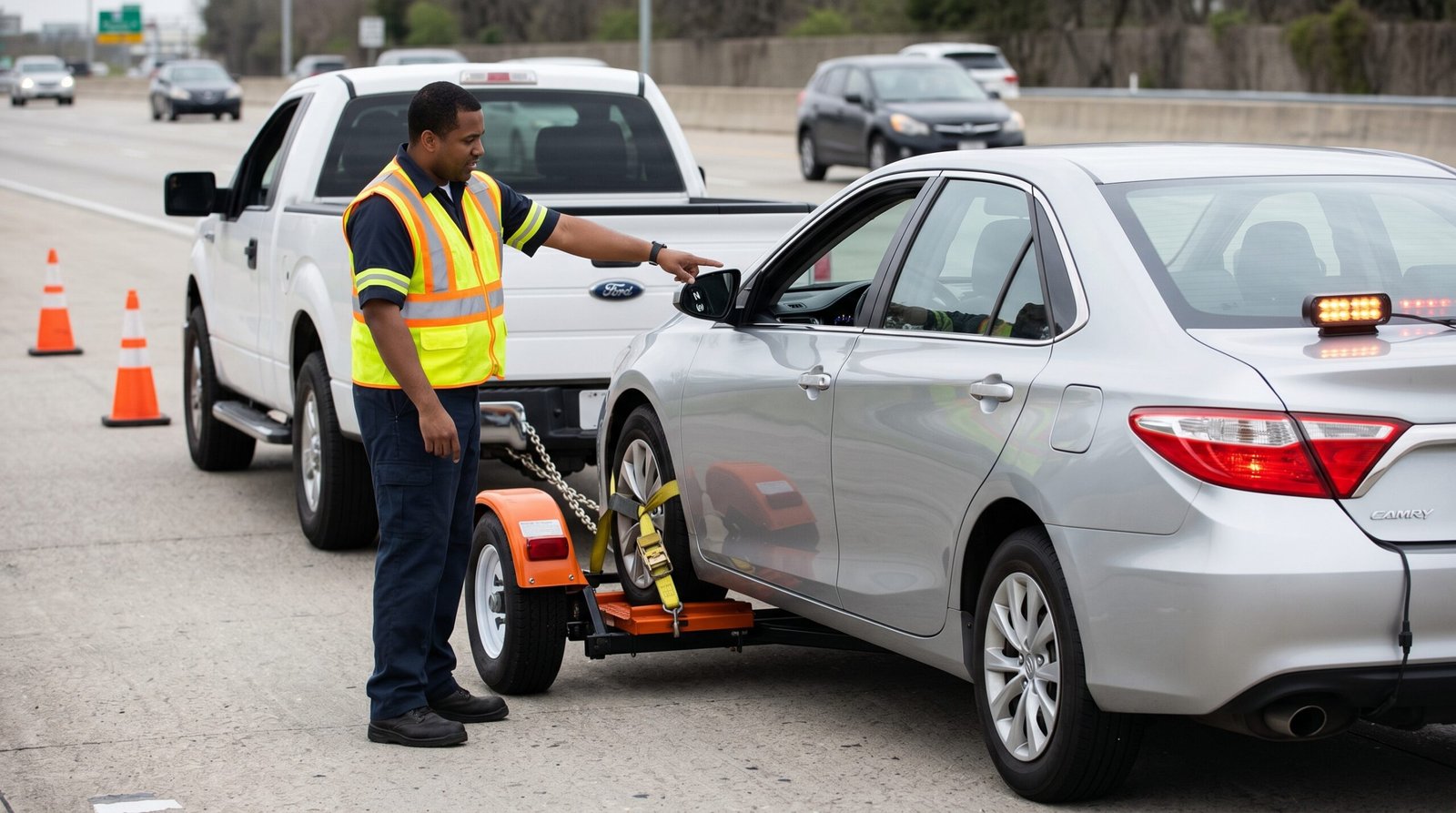
A tow truck may use a wheel-lift system to raise either the front or rear wheels while the other wheels remain on the road.
Whether this is suitable depends on the vehicle’s drivetrain and manufacturer instructions.
For example, a front-wheel-drive vehicle may have different towing requirements from a rear-wheel-drive vehicle.
An AWD vehicle can have different requirements again because multiple axles may be connected through the drivetrain.
This is why it is important to tell the towing provider the exact make, model and drivetrain of the vehicle before towing begins.
What About Front-Wheel-Drive Automatic Cars?
Front-wheel-drive automatic vehicles transfer engine power to the front wheels.
Depending on the specific vehicle and manufacturer instructions, a wheel-lift tow truck may be able to raise the front wheels while the rear wheels remain on the road.
However, this should not be assumed for every vehicle.
The owner’s manual may specify limitations involving:
- Maximum towing speed
- Maximum towing distance
- Transmission position
- Steering requirements
- Parking brake
- Wheel position
- Use of a dolly or other equipment
If the manufacturer recommends transporting the vehicle on a flatbed, that instruction should be followed.
What About Rear-Wheel-Drive Automatic Cars?
Rear-wheel-drive vehicles send engine power to the rear wheels.
If the rear wheels remain on the ground while the vehicle is being towed, components connected to the drivetrain may rotate.
For this reason, manufacturers may specify particular towing procedures or require certain equipment.
Depending on the vehicle, options can include:
- Flatbed towing
- Wheel-lift towing with the correct wheels raised
- Driveshaft disconnection
- A manufacturer-approved towing procedure
The correct method depends on the vehicle.
If you are unsure, professional towing is safer than experimenting with different towing methods.
What About AWD and 4WD Automatic Vehicles?
All-wheel-drive and four-wheel-drive vehicles require particular attention when being towed.
Because power can be distributed between multiple wheels or axles, moving the vehicle with only some wheels lifted may create drivetrain problems on vehicles that are not designed for that method.
Some AWD and 4WD vehicles therefore require all four wheels to be off the ground.
A flatbed tow truck can be appropriate in situations where the manufacturer requires the vehicle to be transported with all wheels elevated.
Before requesting a tow, tell the towing provider if your vehicle has:
- AWD
- 4WD
- A transfer case
- Hybrid or electric drivetrain
- Modified suspension
- Damaged wheels
- Drivetrain problems
This information helps the towing provider determine what equipment may be required.
Does Putting the Car in Neutral Make Towing Safe?
Not necessarily.
Putting an automatic transmission into Neutral allows the transmission to disconnect the engine’s driving force from the wheels, but it does not automatically mean the vehicle can be towed any distance or at any speed.
Other drivetrain components may still rotate as the wheels move.
Some manufacturers permit limited towing in Neutral under specific conditions. Others may require a different towing method.
Always follow the vehicle’s towing instructions rather than assuming Neutral makes every towing situation safe.
Can You Tow an Automatic Car With a Tow Rope?
Using a rope or strap to pull a disabled automatic vehicle can be risky and may not be appropriate for the vehicle.
A simple rope does not provide the same control or equipment as a professional tow truck.
Potential problems include:
- Limited steering control
- Difficulty braking
- Sudden movement
- Damage to towing points
- Damage to the transmission or drivetrain
- Increased risk around traffic
On public roads, attempting an improvised tow can also create additional safety concerns.
If the vehicle is disabled, professional towing equipment is generally the safer option.
What Happens if You Tow an Automatic Car Incorrectly?
Incorrect towing can potentially cause mechanical damage.
Depending on the vehicle and towing method, problems can involve:
- Transmission components
- Drivetrain components
- Transfer cases
- Differential components
- Tires
- Steering components
- Suspension
- Bodywork
Damage is not guaranteed to occur simply because a vehicle was moved, but towing outside the manufacturer’s recommendations can increase the risk of problems.
If a vehicle has already been towed incorrectly and you notice unusual noises, warning lights, fluid leaks or changes in how the vehicle drives, have it inspected before continuing to use it.
What Should You Do Before Your Automatic Car Is Towed?
Before a tow truck arrives, there are several useful things you can check.
1. Check the Owner’s Manual
Look for sections covering:
- Towing
- Emergency towing
- Vehicle recovery
- Flat towing
- Transporting the vehicle
- AWD or 4WD towing
The manufacturer’s instructions should take priority.
2. Identify the Drivetrain
Know whether your vehicle is:
- Front-wheel drive
- Rear-wheel drive
- All-wheel drive
- Four-wheel drive
This information can affect which towing equipment is appropriate.
3. Tell the Tow Operator About Damage
Tell the towing provider if:
- A wheel is damaged.
- A tire is flat.
- The vehicle cannot steer.
- The brakes are damaged.
- The transmission is stuck.
- The vehicle cannot shift into Neutral.
- The vehicle has drivetrain damage.
- The vehicle has been involved in a collision.
A damaged vehicle may require different recovery equipment.
4. Remove Personal Items
Before the vehicle is transported, remove important personal belongings if it is safe to do so.
Also secure loose items inside the vehicle.
5. Take Photos
If the vehicle has been involved in an accident or has visible damage, photographs can document its condition before transportation.
What If the Automatic Car Cannot Shift Into Neutral?
A vehicle that cannot shift into Neutral may require additional towing equipment.
This can happen because of:
- Electrical failure
- Dead battery
- Transmission problems
- Shifter problems
- Mechanical damage
- Collision damage
Do not force the transmission selector if it will not move.
Tell the towing provider that the vehicle cannot be shifted into Neutral. The operator can determine what equipment is needed to safely move the vehicle.
Depending on the situation, a flatbed tow truck or specialised recovery equipment may be appropriate.
What If the Car Has a Dead Battery?
A dead battery does not necessarily mean the vehicle needs to be towed.
If the only problem is a discharged battery, roadside assistance may be able to provide a boost or jump-start.
However, towing may be necessary if:
- The battery is damaged.
- The vehicle still will not start after a boost.
- The alternator has failed.
- The vehicle has another mechanical problem.
- The vehicle is in an unsafe location.
ARM Towing provides battery boost and jump-start assistance in Calgary, with towing available when further transportation is required.
What If the Automatic Vehicle Is Stuck in Snow?
Calgary winters can create situations where a vehicle becomes stuck in snow or ice.
If your automatic vehicle becomes stuck:
- Stay calm.
- Check the area around the vehicle.
- Clear snow around the tires if it is safe.
- Use suitable traction material if available.
- Avoid excessive wheel spinning.
- Do not repeatedly accelerate aggressively.
- Contact professional recovery assistance if the vehicle cannot be safely freed.
If recovery equipment is required, tell the towing provider whether the vehicle is AWD, 4WD or front- or rear-wheel drive.
ARM Towing provides vehicle recovery and towing assistance in Calgary and nearby areas for vehicles stuck in snow, mud or roadside ditches.
Flatbed Towing vs Wheel-Lift Towing
The appropriate towing method depends on the vehicle.
Flatbed Towing
A flatbed tow truck carries the entire vehicle on a platform.
Potential advantages include:
- All four wheels are off the ground.
- Reduced wheel rotation during transport.
- Useful for many AWD and 4WD vehicles.
- Suitable for vehicles with certain drivetrain problems.
- Can be useful for vehicles with significant damage.
Wheel-Lift Towing
A wheel-lift tow truck raises either the front or rear wheels while the remaining wheels stay on the road.
This can be suitable for some vehicles when the manufacturer allows it and the correct wheels are lifted.
However, it is not appropriate for every automatic vehicle.
The towing provider should consider the vehicle’s drivetrain, manufacturer’s instructions and condition before selecting the towing method.
Calgary Winter Towing and Automatic Vehicles
Cold weather can create additional roadside problems for Calgary drivers.
Snow, ice and low temperatures can contribute to:
- Dead batteries
- Flat tires
- Reduced traction
- Vehicles becoming stuck
- Starting problems
- Visibility problems
- Difficult roadside conditions
If your automatic vehicle breaks down during winter, try to move to a safe location if possible and turn on your hazard lights.
Keep warm clothing, blankets, a flashlight, food, water and a charged phone in your vehicle.
If the vehicle is stuck during severe weather, avoid unnecessary exposure to the elements and contact professional assistance.
How Can You Prevent Automatic Transmission Problems?
Proper maintenance can help reduce the risk of transmission-related problems.
Follow the Manufacturer’s Maintenance Schedule
Follow the service recommendations for your particular vehicle.
Different vehicles have different requirements for transmission inspection and fluid service.
Watch for Transmission Warning Signs
Pay attention to:
- Delayed gear engagement
- Slipping
- Grinding
- Shuddering
- Unusual noises
- Burning smells
- Fluid leaks
- Warning lights
Have unusual symptoms inspected rather than waiting for a complete transmission failure.
Check for Fluid Leaks
If you notice fluid underneath your vehicle, do not automatically assume it is harmless.
Different fluids can indicate different problems.
A qualified technician can identify the source of the leak and determine whether the vehicle is safe to drive.
Avoid Unnecessary Stress
Follow the manufacturer’s recommendations for towing, heavy loads and driving conditions.
If the vehicle is experiencing transmission problems, avoid putting additional stress on the drivetrain until it has been inspected.
When Should You Call a Calgary Tow Truck?
You should consider professional towing when:
- The vehicle cannot safely continue driving.
- The transmission has failed.
- The vehicle cannot shift properly.
- The drivetrain has been damaged.
- The vehicle is AWD or 4WD and the correct towing method is uncertain.
- The vehicle cannot be shifted into Neutral.
- The vehicle has suffered collision damage.
- The vehicle has serious brake or steering problems.
- The vehicle is stuck and requires recovery equipment.
- The manufacturer requires a specific towing method you cannot perform yourself.
When in doubt, avoid improvising.
Tell the towing provider the vehicle’s make, model, drivetrain and condition so the appropriate equipment can be considered.
ARM Towing provides 24/7 towing and roadside assistance in Calgary and nearby areas, including vehicle recovery and flatbed towing services.
What Information Should You Give the Tow Truck Driver?
When arranging a tow, provide:
- Vehicle make and model
- Model year if known
- Front-wheel, rear-wheel or all-wheel drive
- Exact location
- Description of the problem
- Whether the vehicle starts
- Whether the vehicle can move
- Whether the transmission can shift into Neutral
- Whether the wheels or tires are damaged
- Whether the vehicle was involved in a collision
- Your preferred destination
The more information you provide, the easier it can be for the towing provider to determine what type of assistance may be required.
Roadside Towing Safety Comes First
Towing an automatic vehicle is not simply about getting it from one location to another.
The vehicle needs to be moved in a way that considers its transmission, drivetrain, wheels and overall condition.
If you are stopped on a busy Calgary road, turn on your hazard lights and move to a safe location if possible.
Do not attempt to improvise a towing method that could put you, other road users or the vehicle at risk.
If the vehicle has serious mechanical damage, is involved in a collision or cannot be safely moved, professional towing is the safer option.
For an immediate emergency involving injuries or an imminent threat to life, contact 911.
Final Towing Checklist for Automatic Transmission Vehicles
Automatic vehicles can be towed, but the correct method depends on the specific vehicle and its manufacturer’s requirements.
Before towing, identify the vehicle’s drivetrain, check the owner’s manual and tell the towing provider about any mechanical or wheel damage.
Remember the essentials:
Check the manufacturer’s instructions. Know your drivetrain. Use the correct towing equipment. Do not improvise when safety or vehicle damage is a concern.
For Calgary drivers, professional towing can help ensure a disabled automatic vehicle is transported using equipment appropriate for its condition.
If you need towing, roadside assistance, flatbed transportation or vehicle recovery in Calgary, ARM Towing provides 24/7 towing and roadside assistance in Calgary and nearby areas.
Frequently Asked Questions
Can you tow a car with an automatic transmission?
Yes, but the correct towing method depends on the vehicle’s transmission, drivetrain and manufacturer instructions. Some vehicles can be moved with certain wheels on the ground under specific conditions, while others may require flatbed transportation.
Is it safe to tow an automatic car in Neutral?
Not always. Putting the transmission in Neutral does not automatically make every towing method safe. Follow the manufacturer’s instructions for the specific vehicle.
Is flatbed towing better for automatic cars?
A flatbed can be appropriate for vehicles that need all four wheels off the ground, including some AWD and 4WD vehicles. However, not every automatic vehicle requires a flatbed. The manufacturer’s towing instructions should determine the appropriate method.
Can you tow an AWD automatic vehicle with two wheels on the ground?
It depends on the specific vehicle. Some AWD systems may be damaged if the vehicle is towed incorrectly. Check the owner’s manual and inform the towing provider that the vehicle is AWD before arranging transportation.
Can a dead battery damage an automatic transmission?
A dead battery itself does not normally mean the transmission is damaged. However, a vehicle with a dead battery may need specific procedures or equipment if it must be moved and cannot be shifted into Neutral.
Can I tow an automatic car with a rope?
Improvised rope towing can create safety and vehicle-damage risks. Professional towing equipment is generally a safer option for transporting a disabled vehicle, particularly on public roads.
What should I do if my automatic car cannot shift into Neutral?
Do not force the gear selector. Tell the towing provider that the vehicle cannot be shifted into Neutral so they can determine the appropriate recovery equipment and procedure.
Should I use a flatbed for a damaged automatic transmission?
A vehicle with transmission or drivetrain damage may benefit from being transported with all wheels off the ground, but the appropriate method depends on the vehicle and the type of damage. A professional towing provider can determine the appropriate equipment.
Does ARM Towing provide flatbed towing in Calgary?
Yes. ARM Towing provides towing and roadside assistance in Calgary and nearby areas, including flatbed towing and vehicle recovery services. The appropriate towing method depends on the vehicle and its condition.

Moussa El Haddaoui is a digital content creator, web developer, and SEO specialist with a background in English Studies. He writes engaging, informative content and builds websites focused on user experience, search visibility, and quality. His interests include web development, AI automation, digital marketing, and creating useful online experiences.