A flat tyre can happen at the worst possible moment. You might be driving along Deerfoot Trail, joining Stoney Trail, heading down Crowchild Trail or travelling on a busy Calgary road when you suddenly hear a loud bang or feel your vehicle pulling to one side.
Your first instinct might be to brake hard, stop immediately or try to reach the nearest garage. However, the safest response depends on where you are, how badly the tyre is damaged and whether your vehicle can still be controlled.
A flat tyre is not always a reason to tow a vehicle. But when the damage is severe, the road is dangerous or you cannot change the tyre safely, roadside assistance or a tow truck may be the better choice.
This guide explains what to do when you get a flat tyre in Calgary, how to recognise serious tyre damage and when to arrange professional assistance.
Quick Checklist: What to Do When You Get a Flat Tyre
If you suspect a tyre has failed while driving:
- Keep a firm grip on the steering wheel.
- Avoid sudden braking or sharp steering movements.
- Ease off the accelerator gradually.
- Look for a safe place away from moving traffic.
- Switch on your hazard lights when appropriate.
- Avoid stopping on a blind bend or narrow shoulder if you can safely reach a better location.
- Do not stand beside your vehicle close to fast-moving traffic.
- Inspect the tyre only when you are in a safe location.
- Use a spare tyre only if you have the correct equipment and can change it safely.
- Call roadside assistance or towing if the vehicle cannot be moved safely.
The most important rule: reaching a safe stopping place matters more than saving the tyre or protecting the wheel from damage.
1. How to Recognise a Flat Tyre While Driving
Not every tyre failure begins with a loud bang. Sometimes the symptoms develop gradually.
Watch for these warning signs.
The steering wheel suddenly pulls to one side
If a front tyre loses pressure, your vehicle may begin pulling strongly in one direction. A damaged rear tyre may cause the vehicle to feel unstable or weave.
Avoid sudden steering corrections. Reduce speed gradually and find a safe place to stop.
You hear flapping, thumping or grinding noises
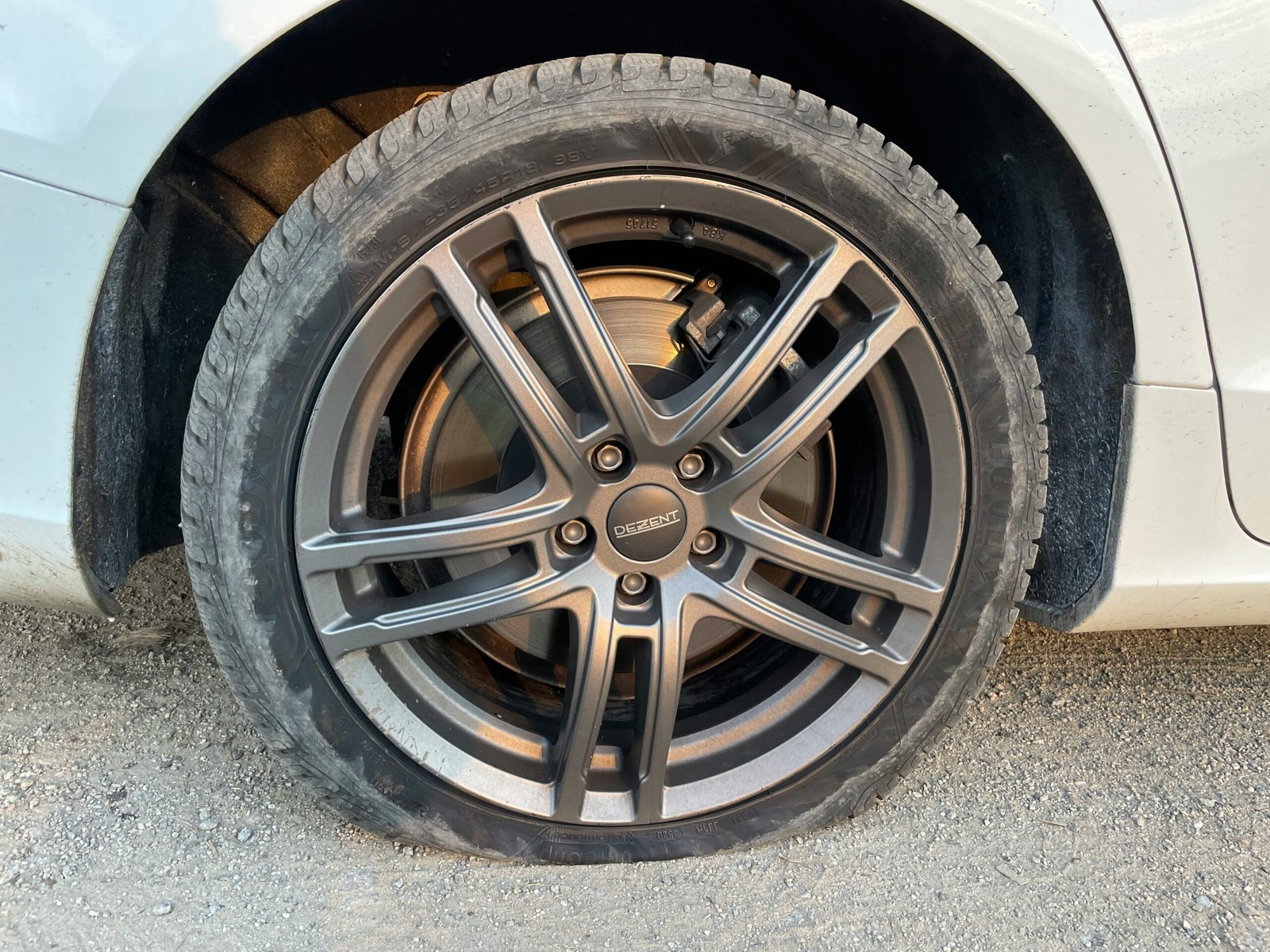
A deflated tyre can make a repeated flapping sound as the damaged rubber contacts the road. If the tyre is completely flat, the wheel may begin contacting the road surface.
Continuing to drive can damage the wheel and surrounding components.
The vehicle starts vibrating
A sudden vibration may indicate tyre damage, a damaged wheel or another mechanical problem.
Do not assume that every vibration is caused by low pressure. If the vehicle feels unstable, stop somewhere safe and arrange an inspection.
The tyre pressure warning light appears
A tyre pressure monitoring system can alert you to a pressure problem, but it does not tell you that the tyre is safe to drive on.
If the tyre looks visibly deflated or the vehicle handles differently, do not continue driving simply because you are close to your destination.
2. What to Do If a Tyre Blows Out on Deerfoot Trail or Stoney Trail
A tyre blowout on a busy road is especially stressful because other vehicles may be travelling at high speed.
Your priority is to maintain control and avoid creating another hazard.
Step 1: Keep the steering steady
Hold the steering wheel firmly and avoid abrupt movements. Do not slam on the brakes.
Step 2: Ease off the accelerator
Allow the vehicle to slow down gradually. Avoid sudden acceleration or sharp turns.
Step 3: Move towards a safer stopping place
If the vehicle remains controllable, move away from moving traffic when it is safe to do so.
Do not attempt a difficult manoeuvre across several lanes just to reach a particular exit.
Step 4: Switch on your hazard lights
Use your hazard lights to warn other drivers when appropriate.
Step 5: Assess your location before leaving the vehicle
A narrow highway shoulder can be dangerous. Avoid standing beside your car where passing traffic could strike you.
If you are unsure how to reach a safer position, prioritise staying out of traffic and contacting appropriate assistance.
If your vehicle is in a live lane or creates an immediate danger, contact emergency services.
For additional guidance on driving safely during difficult conditions, see Alberta’s official road safety information.
3. Should You Change a Flat Tyre Yourself?
Changing a tyre yourself may be possible when you are parked on a firm, level surface away from traffic and have the correct equipment.
However, having a spare tyre does not automatically make a roadside tyre change safe.
Before attempting it, consider the following.
Check the location
A quiet parking area is very different from the shoulder of a busy highway.
Avoid changing a tyre where vehicles pass close to you, where the ground is unstable or where you cannot position the vehicle safely.
Check your equipment
You may need:
- A suitable spare tyre
- A vehicle jack
- A wheel wrench
- The correct locking wheel-nut key, if applicable
- Your vehicle owner’s manual
Some vehicles do not carry a full-size spare. Others use a temporary spare or a tyre repair kit.
Check the damage
A spare tyre will not solve every problem.
If the wheel is bent, the suspension is damaged or the tyre has come apart, the vehicle may need professional recovery.
Know when to stop
If the jack will not sit securely, the wheel nuts will not loosen or the vehicle is positioned unsafely, do not improvise.
Professional assistance is preferable to risking an injury beside traffic.
4. When a Flat Tyre Means You Need a Tow Truck
Some tyre problems can be resolved with a spare tyre or roadside service. Others require towing.
Consider a tow when any of the following situations applies.
The tyre has been shredded
A severely damaged tyre may no longer be repairable at the roadside. If you do not have a usable spare, the vehicle may need to be transported to a tyre shop or repair facility.
The wheel is damaged
Driving on a flat tyre can damage the wheel itself. A bent or cracked wheel may not hold air properly or may affect vehicle control.
If the wheel is visibly damaged, avoid driving on it.
The vehicle has suspension damage
A severe pothole impact or blowout can sometimes be accompanied by damage to the suspension or steering.
If the vehicle sits unevenly, pulls strongly to one side or makes unusual mechanical noises, arrange an inspection rather than continuing.
You have no spare tyre
Many modern vehicles are supplied without a traditional spare wheel.
If you have no suitable spare and the tyre cannot be repaired where you are, towing may be necessary.
You are stopped somewhere dangerous
A tyre that could be changed in a driveway may present a very different problem on a busy highway shoulder.
If there is not enough space to work safely, do not put yourself at risk just to avoid a tow.
For related advice, read ARM Towing’s guide to roadside assistance in Calgary.
5. Can You Drive a Short Distance on a Flat Tyre?
In most situations, driving on a completely flat conventional tyre is a bad idea.
Even a short distance can cause further damage to the tyre, wheel and potentially other vehicle components.
It can also make the vehicle harder to control.
There is an important distinction between a tyre that is slightly underinflated and one that has lost most or all of its air.
If you suspect a complete loss of pressure, stop as soon as you can do so safely.
What about run-flat tyres?
Some vehicles use run-flat tyres designed to allow limited driving after a loss of pressure, subject to the manufacturer’s conditions.
However, the permitted distance and speed depend on the tyre and vehicle.
Check the owner’s manual and tyre manufacturer’s instructions. Do not assume a run-flat tyre can be driven indefinitely or that it remains safe after every type of damage.
If the tyre has been badly damaged, the wheel is affected or the vehicle feels unstable, arrange professional assistance.
6. Calgary Roads, Potholes and Sudden Tyre Damage
Calgary drivers encounter changing road conditions throughout the year.
Potholes, sharp road debris, construction areas and seasonal temperature changes can all contribute to tyre problems.
Potholes
A hard impact can damage a tyre sidewall, bend a wheel or affect alignment.
Sometimes the damage is not obvious until you notice a vibration or pressure loss later.
If a pothole impact is followed by a bulge in the tyre, a rapid pressure drop or unusual handling, stop driving and have the vehicle assessed.
Road debris
Metal fragments, screws and other sharp objects can puncture a tyre.
A small puncture in the tread may sometimes be repairable, but damage to the sidewall or shoulder usually requires a different response.
Do not pull a large object out of the tyre before you understand the situation. Removing it may cause air to escape more quickly.
Cold weather
Cold temperatures can reduce tyre pressure. This does not mean cold weather automatically causes a blowout, but incorrect pressure can affect tyre performance and increase the risk of damage.
Check tyre pressures regularly using the pressure recommended by your vehicle manufacturer, usually listed on the driver’s door-jamb label or in the owner’s manual.
For more winter preparation advice, read Alberta’s Safer Winter Highways guidance.
7. What If You Get a Flat Tyre at Night or in Winter?
A flat tyre becomes more challenging when visibility is poor, temperatures are low or roads are slippery.
Before attempting any repair, consider whether you can work safely in your current location.
At night
Darkness makes it harder for other drivers to see you. A narrow shoulder can be particularly hazardous when vehicles approach at speed.
Use your hazard lights when appropriate and contact assistance if you cannot reach a safe place to change the tyre.
During a snowstorm
Snow can hide potholes, debris and uneven ground. It may also make it harder to position a jack securely.
Avoid attempting a tyre change on an unstable or slippery surface.
In extreme cold
If you are stranded, keep yourself warm and avoid unnecessary exposure to the weather.
Carry suitable winter clothing, a charged phone and emergency supplies when travelling in winter.
Alberta recommends preparing your vehicle for winter, checking tyres and carrying an emergency kit. Its winter highway guidance provides a useful preparation checklist.
8. What Happens When You Call for Roadside Assistance?
When you request assistance, providing accurate information helps the operator understand what is needed.
Be prepared to explain:
- Your exact location or nearest intersection
- The road or highway you are on
- Your direction of travel, if relevant
- Your vehicle’s make and model
- Whether the tyre is completely flat
- Whether the wheel appears damaged
- Whether you have a spare tyre
- Whether the vehicle is blocking traffic
- Whether the vehicle has other warning signs or mechanical problems
If you are on a highway, a location pin and nearby exit or landmark can help identify where you are.
Do not stand near moving traffic to take photographs or obtain a more precise location.
Will you need a tyre change or a tow?
That depends on the vehicle, tyre damage, available equipment and your location.
If a safe roadside tyre change is possible, roadside assistance may be sufficient.
If the tyre cannot be replaced safely, the wheel is damaged or the vehicle has another mechanical issue, towing may be the appropriate option.
You can also review ARM Towing’s guide to 24/7 towing in Calgary.
9. How to Avoid Further Damage After a Flat Tyre
Once you have stopped, a few simple precautions can prevent a difficult situation from becoming worse.
- Do not continue driving on a completely flat conventional tyre.
- Do not attempt to straighten a visibly damaged wheel yourself.
- Do not use an unsuitable tyre sealant without checking whether it is compatible with your vehicle.
- Do not position a jack on soft, sloping or unstable ground.
- Do not crawl underneath a vehicle supported only by a jack.
- Do not ignore steering problems or unusual noises after a tyre failure.
- Do not assume that installing a spare resolves damage to the suspension or wheel.
If the vehicle has suffered an impact, inspect it for other obvious signs of damage once it is safely parked.
A tyre failure may be the only problem, but it is worth checking before continuing your journey.
10. How to Prepare for a Flat Tyre Before It Happens
You cannot prevent every puncture or blowout, but you can make the situation easier to manage.
Check tyre pressure regularly
Use the pressure specified by the vehicle manufacturer rather than relying on the maximum pressure printed on the tyre sidewall.
Inspect the tread and sidewalls
Look for uneven wear, cuts, cracks, bulges and embedded objects.
A visible sidewall bulge is a serious warning sign and should be assessed promptly.
Know whether your vehicle has a spare
Check whether your car has a full-size spare, temporary spare, repair kit or run-flat tyres.
If you have a spare, make sure it is usable and that the necessary tools are present.
Keep emergency equipment in the car
Useful items include:
- A charged mobile phone or power bank
- A torch
- Reflective equipment
- Warm clothing and gloves
- A first-aid kit
- Drinking water
- Your vehicle assistance details
Plan for winter conditions
Check your tyres before long journeys and give yourself extra time when Calgary roads are icy or snow-covered.
Avoid travelling during severe conditions when the journey can safely be postponed.
11. Give Roadside Workers Room to Work
When a tow truck or roadside assistance vehicle arrives, the situation is not automatically safe.
Passing traffic can put both the driver and the roadside worker at risk.
Alberta’s roadside worker safety rules require drivers approaching a stopped roadside vehicle with flashing lights to move to the far lane when safe. If they cannot safely move over, they must slow to 60 km/h or the posted speed limit, whichever is lower.
You can read the official requirements on Alberta’s Roadside Worker Safety page.
If your vehicle is being assisted beside a busy road, follow the operator’s safety instructions and remain in a safe location.
Frequently Asked Questions
Can I call a tow truck for a flat tyre in Calgary?
Yes. If the tyre cannot be changed safely, you have no usable spare or the wheel is damaged, you can arrange towing to a suitable repair facility.
Should I drive on a flat tyre to the nearest garage?
Generally, no. Driving on a completely flat conventional tyre can damage the wheel and other components. Stop somewhere safe and arrange assistance.
Can a tow truck take my car to a tyre shop?
You can arrange for the vehicle to be transported to a tyre shop or another suitable destination, subject to the towing provider’s service and your arrangements with the destination.
What if I have a spare tyre but am on Deerfoot Trail?
Having a spare does not mean the location is safe for a tyre change. If traffic is close or there is insufficient working space, contact roadside assistance rather than attempting the repair beside fast-moving vehicles.
Does a flat tyre always mean the wheel is damaged?
No. Some punctures affect only the tyre. However, driving on a flat tyre or striking a pothole can damage the wheel, so inspect it before continuing.
Can cold weather cause a flat tyre?
Cold temperatures can lower tyre pressure, while punctures, impact damage and other problems can also cause pressure loss. Check tyre pressure regularly and investigate repeated pressure loss.
How can I tell whether I need roadside assistance or towing?
A safe, repairable puncture may be handled through roadside assistance. Severe tyre damage, a damaged wheel, unsafe stopping conditions or additional mechanical problems may make towing the better option.
Need Help With a Flat Tyre in Calgary?
A flat tyre can disrupt your plans, but it should never force you to take unnecessary risks beside a busy road.
If you can reach a safe location and the tyre can be replaced properly, a roadside tyre change may be enough. If the vehicle is unsafe to drive, you have no usable spare or the wheel has been damaged, professional towing can help get the vehicle to a suitable repair facility.
ARM Towing can assist when a vehicle needs roadside support or transportation after a tyre problem.
Whether you are dealing with a puncture in a parking lot or a damaged wheel on a busy Calgary route, put safety first, avoid driving on a flat tyre and choose the right assistance for the situation.

Moussa El Haddaoui is a digital content creator, web developer, and SEO specialist with a background in English Studies. He writes engaging, informative content and builds websites focused on user experience, search visibility, and quality. His interests include web development, AI automation, digital marketing, and creating useful online experiences.