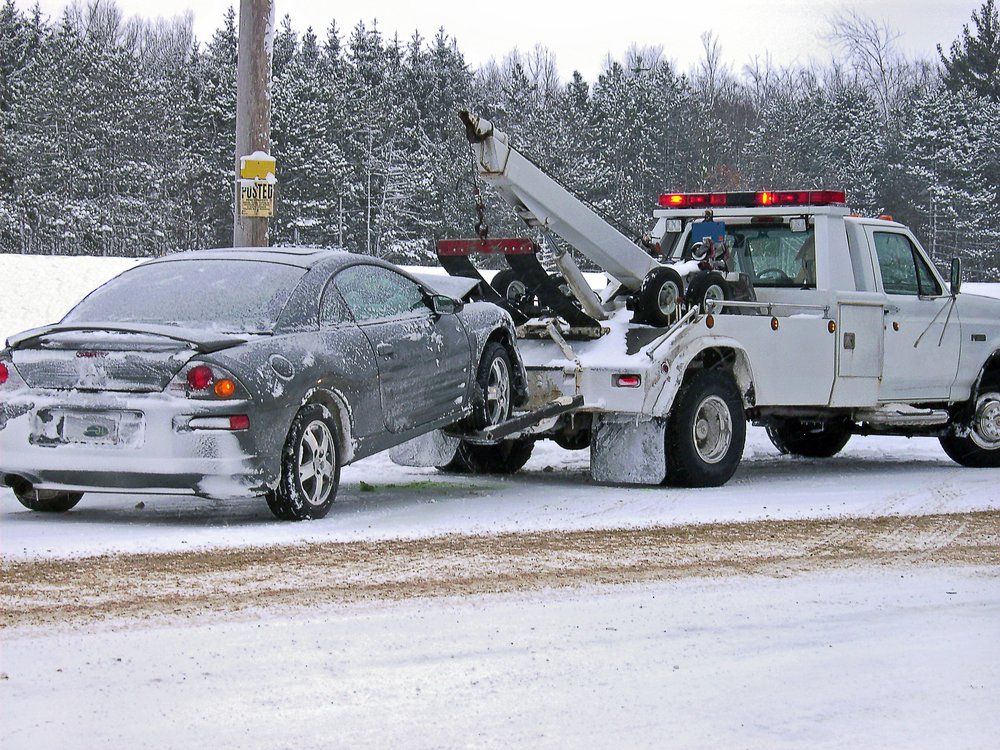
Getting stuck in snow can happen even to experienced Calgary drivers. A vehicle may lose traction in a residential street, parking lot, driveway, alley or unplowed road. Deep snow, packed ice, steep surfaces and hidden ruts can make it difficult to move, especially during a Calgary winter storm.
The first reaction is often to press the accelerator and try to drive out. However, repeated wheel spinning can make the situation worse by digging the tires deeper into the snow.
Knowing what to do when your car gets stuck can help you avoid unnecessary damage and decide when it is time to call for professional roadside assistance or vehicle recovery.
Quick Snow Recovery Checklist
If your vehicle is stuck in snow, start with these basic steps:
- Stay calm and assess the situation.
- Turn on your hazard lights if you are stopped where other vehicles may approach.
- Check whether the exhaust pipe is clear of snow.
- Remove snow from around the tires.
- Straighten the steering wheel where possible.
- Use a shovel to clear a path in front of the drive wheels.
- Try gentle acceleration instead of spinning the wheels.
- Use traction material such as sand or suitable road salt if available.
- Avoid repeated attempts if the vehicle is sinking deeper.
- Call roadside assistance or a tow truck if you cannot safely recover the vehicle.
Alberta guidance recommends carrying an emergency road kit and taking extra care during winter conditions.
Why Cars Get Stuck in Calgary Snow
There is no single reason a vehicle becomes stuck. Several conditions can combine to reduce traction.
Deep Snow
Fresh or packed snow can become deep enough that the underside of the vehicle starts resting on the snow.
When this happens, the tires may no longer have enough contact with the road surface to move the vehicle effectively.
Packed Ice Under the Tires
Snow can become compacted under repeated traffic. If ice forms underneath the tires, simply pressing the accelerator harder may not help.
The tires can spin while the vehicle remains in the same position.
Wheel Spin
Wheel spin is one of the most common mistakes when trying to escape snow.
Spinning tires can remove snow from underneath the tread and create deeper holes. The vehicle may then sit lower and become even more difficult to move.
Inclines and Slopes
A small hill that is manageable in normal conditions can become difficult when covered with snow or ice.
A vehicle may lose momentum while climbing and then slide or become stuck.
Snow Around the Vehicle
Snow can accumulate around the front, rear or underneath the vehicle. If enough snow builds up, it can physically prevent the car from moving.
Step 1: Stop Spinning the Wheels
If your vehicle is not moving, do not keep accelerating aggressively.
Instead, take your foot off the accelerator and allow the wheels to stop spinning.
This gives you an opportunity to assess why the vehicle is stuck.
Ask yourself:
- Are the tires buried?
- Is snow packed underneath the vehicle?
- Is the vehicle sitting on ice?
- Are the drive wheels on a slope?
- Is another part of the vehicle resting on snow?
- Is there enough room to move forward or backward?
If the vehicle is sinking deeper with every attempt, stop trying to drive out.
Step 2: Check the Exhaust Pipe
Before running the engine for an extended period while stationary, check that the exhaust outlet is not blocked by snow.
Snow around an exhaust pipe can create a dangerous situation because exhaust gases can accumulate around or inside the vehicle.
Alberta’s guidance specifically warns drivers stranded in winter conditions to keep the exhaust pipe clear and ventilate the vehicle when the engine is running.
If visibility is poor or conditions are dangerous, stay inside the vehicle and seek assistance rather than repeatedly getting out.
Step 3: Clear Snow Around the Tires
If it is safe to exit the vehicle, use a shovel to remove snow from around the tires.
Concentrate on creating a path in the direction you intend to travel.
For example, if you are trying to move forward, clear the snow immediately in front of the drive wheels.
Also check underneath the vehicle if it is safe to do so.
Do not crawl underneath a vehicle that is sitting in an unstable position.
Step 4: Straighten the Steering Wheel
If the front wheels are turned sharply, they can create additional resistance when you try to move.
Straighten the steering wheel when possible and attempt to move gradually.
If the vehicle is equipped with traction-control or drive modes designed for slippery conditions, consult the owner’s manual to understand how they should be used.
Different vehicles behave differently, particularly four-wheel-drive, all-wheel-drive, hybrid and electric vehicles.
Step 5: Create Traction
If your tires are sitting on slippery snow or ice, adding traction underneath them may help.
Depending on the situation, drivers may use:
- Sand
- Road salt
- Commercial traction material
- A suitable traction mat
- Other manufacturer-approved recovery equipment
Place traction material where the drive wheels need it.
The goal is to give the tires something more substantial to grip rather than simply adding more engine power.
Step 6: Try Gentle Acceleration
Once you have cleared the snow and created a path, try moving the vehicle slowly.
Avoid flooring the accelerator.
Use gentle throttle input and allow the tires to maintain traction.
If the vehicle starts moving, keep the momentum controlled and avoid making sudden steering or acceleration changes.
If it immediately starts spinning again, stop and reassess.
Rocking a Vehicle: When to Be Careful
Some drivers attempt to rock a stuck vehicle by moving between forward and reverse.
This can sometimes help in suitable situations, but it should not be done aggressively.
Repeatedly shifting between drive and reverse while the wheels are spinning can place unnecessary stress on the drivetrain.
Always follow the vehicle manufacturer’s instructions for recovery and transmission use.
If the vehicle is deeply stuck, rocking it repeatedly may also make the situation worse.
When You Should Stop Trying to Free the Vehicle
Knowing when to stop is just as important as knowing what to try.
Consider professional roadside assistance when:
- The tires are deeply buried.
- The vehicle is sitting on its underbody.
- The car is stuck on a steep or icy slope.
- The vehicle keeps sinking deeper.
- You cannot safely clear the snow.
- The vehicle has suffered mechanical damage.
- You are blocking traffic.
- Visibility is poor.
- Weather conditions are deteriorating.
- You have already tried basic recovery techniques without success.
Continuing to spin the wheels rarely solves a deeply stuck vehicle.
In some situations, it can turn a simple snow recovery into a more difficult recovery job.
AWD, 4WD and 2WD Vehicles in Snow
Having all-wheel drive or four-wheel drive can improve traction in certain conditions, but it does not make a vehicle impossible to get stuck.
Tires still need adequate grip.
An AWD or 4WD vehicle can become stuck in deep snow just like a front-wheel-drive or rear-wheel-drive vehicle.
The type of drivetrain also matters when recovering or towing a disabled vehicle.
If your vehicle needs to be moved, tell the towing operator whether it is:
- Front-wheel drive
- Rear-wheel drive
- All-wheel drive
- Four-wheel drive
- Hybrid
- Electric
The vehicle’s owner’s manual should also be checked for specific towing and recovery requirements.
What About Electric and Hybrid Vehicles?
Electric and hybrid vehicles require additional care during recovery.
Their towing and recovery procedures can differ from conventional petrol or diesel vehicles.
Do not assume that because a vehicle has AWD or electric motors, it can be recovered in exactly the same way as another car.
Before moving the vehicle, provide the tow operator with the exact make, model and drivetrain.
If the vehicle has been involved in a collision or has visible damage to its battery area, wheels or underbody, avoid attempting an improvised recovery.
What to Do If You Are Stuck During a Calgary Snowstorm
Being stuck during a major snowstorm is different from getting stuck in a relatively quiet parking lot.
Your priority should be safety.
If your vehicle is in a safe location, staying with it is generally recommended during serious winter conditions. Alberta guidance also recommends checking current road conditions before travelling and using Alberta 511 for updates.
If you are stranded:
- Turn on your hazard lights when appropriate.
- Call for assistance.
- Stay with your vehicle if it is safer than leaving it.
- Keep yourself warm.
- Keep the exhaust area clear of snow.
- Ventilate the vehicle when running the engine.
- Monitor changing weather and road conditions.
- Call 911 if there is an immediate emergency.
Do not walk a long distance through severe weather simply because you are frustrated with the situation.
Check Calgary Road Conditions Before You Travel
Winter recovery often begins before the vehicle leaves the driveway.
Before a longer trip, check current road conditions and closures through Alberta 511.
The system provides information about road conditions, closures, incidents, reduced visibility and other travel conditions.
This is particularly important before travelling outside Calgary during a significant winter storm.
Keep a Winter Recovery Kit in Your Vehicle
A basic winter emergency kit can make a major difference if your vehicle loses traction.
Consider keeping:
- Compact snow shovel
- Ice scraper
- Snow brush
- Gloves
- Warm blanket
- Extra winter clothing
- Flashlight
- Portable phone charger
- Jumper cables or appropriate battery equipment
- Sand or traction material
- Warning equipment
- Drinking water
- Basic first-aid supplies
Alberta’s Driver’s Guide also recommends winter emergency supplies such as blankets, extra clothing, sand or road salt, a shovel, an ice scraper and snow brush.
When to Call a Calgary Tow Truck for Snow Recovery
Not every stuck vehicle needs a tow truck.
Sometimes clearing snow and adding traction is enough.
However, professional recovery becomes more appropriate when the vehicle is deeply buried, sitting on its underbody, positioned dangerously, damaged or unable to move without excessive wheel spin.
A professional towing operator can assess the situation and determine how the vehicle should be recovered.
This can be particularly important for vehicles with specialised drivetrains or low ground clearance.
What Information to Give the Tow Truck Operator
When requesting snow recovery or towing in Calgary, provide as much useful information as possible.
Tell the operator:
- Your exact location
- Your vehicle’s make and model
- Whether it is AWD, 4WD, FWD or RWD
- Whether it is hybrid or electric
- How deeply the vehicle is stuck
- Whether the wheels are spinning
- Whether the vehicle is damaged
- Whether you are on a road, driveway, parking lot or private property
- Whether the vehicle is blocking traffic
If possible, send a photo showing how the vehicle is positioned.
This can help the towing company understand what type of recovery situation it may be dealing with.
Snow Recovery vs Regular Towing
Snow recovery and ordinary towing are not always the same situation.
A vehicle that has simply stopped running on a clear road may only need transportation.
A vehicle buried in snow may first need to be recovered before it can be safely transported.
The recovery method depends on the vehicle, location, depth of snow, ground conditions and how the vehicle is positioned.
That is why giving accurate information when you call is important.
How to Prevent Getting Stuck in Calgary Snow
You cannot eliminate every winter driving risk, but you can reduce the chance of becoming stuck.
Before winter travel:
- Check your tires.
- Maintain the vehicle’s battery.
- Keep the windshield clear.
- Check your heating system.
- Carry a winter emergency kit.
- Keep the fuel or battery level at a sensible level for the journey.
- Check weather and road conditions.
- Allow additional travel time.
- Avoid unnecessary travel during severe conditions.
Alberta recommends maintaining key vehicle systems before winter and carrying appropriate emergency supplies.
What Not to Do When Your Vehicle Is Stuck
Avoid these common mistakes:
Do Not Keep Flooring the Accelerator
More power does not necessarily mean more traction.
Do Not Ignore Deep Snow Under the Vehicle
If the vehicle is resting on snow, clearing around the tires may not be enough.
Do Not Crawl Under an Unstable Vehicle
Never place yourself underneath a vehicle that could move or shift.
Do Not Continue Driving if the Vehicle Is Damaged
If you notice unusual noises, leaking fluids, damaged wheels or other signs of mechanical damage, stop attempting to drive.
Do Not Take Unnecessary Risks in a Snowstorm
If conditions are deteriorating, safety should come before getting the vehicle moving immediately.
Calgary Snow Recovery FAQ
Can I get my car out of snow without a tow truck?
Sometimes. If the vehicle is only lightly stuck, clearing snow and creating traction may be enough. Deep snow, ice, an unstable position or mechanical damage may require professional recovery.
Does AWD prevent a car from getting stuck?
No. AWD can help provide traction, but it cannot overcome every combination of deep snow, ice, poor tires or difficult terrain.
Should I keep spinning my tires to get unstuck?
No. Excessive wheel spin can dig the tires deeper and make recovery more difficult.
Should I use sand under my tires?
Sand or another suitable traction material can sometimes improve grip when placed under the drive wheels. Use it as part of a controlled recovery attempt rather than relying on increased engine power.
What if my car is buried up to the bottom?
If snow is packed underneath the vehicle or the vehicle is resting on its underbody, stop repeated driving attempts and request professional recovery.
Can a tow truck recover a vehicle stuck in deep snow?
A towing or recovery operator can assess the vehicle and determine an appropriate recovery method based on its position, drivetrain, ground conditions and equipment available.
Is it safer to leave my car during a snowstorm?
If the vehicle is in a safe location, Alberta guidance generally recommends staying with the vehicle when stranded in serious winter conditions. If there is an immediate danger, call 911 and follow emergency instructions.
What should I tell a Calgary towing company when my vehicle is stuck?
Give your exact location, vehicle make and model, drivetrain, depth of snow, vehicle position and any visible damage. Mention whether the vehicle is AWD, 4WD, hybrid or electric.
Final Snow Recovery Checklist
Before attempting to free a stuck vehicle, remember:
- Stop excessive wheel spin.
- Assess the situation.
- Check the exhaust area.
- Clear snow around the drive wheels.
- Create a path.
- Add suitable traction material.
- Use gentle acceleration.
- Avoid aggressive rocking.
- Stop if the vehicle continues sinking.
- Call professional recovery when necessary.
- Stay with the vehicle during severe winter conditions when it is safe to do so.
Getting stuck in snow does not always mean your vehicle needs a tow. But once basic recovery attempts stop working, continuing to force the vehicle can create additional problems.
For Calgary drivers who need help with a stuck vehicle, breakdown or winter roadside emergency, ARM Towing can provide towing and roadside assistance based on the situation.
When Calgary winter conditions leave you stuck, focus on safety first and get the right help when you need it.

Moussa El Haddaoui is a digital content creator, web developer, and SEO specialist with a background in English Studies. He writes engaging, informative content and builds websites focused on user experience, search visibility, and quality. His interests include web development, AI automation, digital marketing, and creating useful online experiences.