Electric vehicles are becoming more common on Calgary roads, but towing an EV is not always the same as towing a conventional petrol or diesel vehicle. Electric cars use high-voltage battery systems and electric drive units, so the wrong towing method can potentially damage the vehicle.
Whether your EV has run out of charge, been involved in an accident, become stuck in snow, or simply will not start, knowing how electric vehicle towing works can help you avoid unnecessary damage and stay safe while waiting for assistance.
ARM Towing provides 24/7 towing and roadside assistance throughout Calgary and nearby areas, including flatbed towing, vehicle recovery and emergency roadside support.
Why Electric Vehicles Require Special Towing Considerations
An electric vehicle does not have a conventional engine and transmission that can simply be placed in neutral and pulled behind a tow truck.
Instead, EVs use electric motors connected to the wheels and a high-voltage battery system. Depending on the vehicle, allowing the drive wheels to rotate while being towed can potentially cause damage to the drivetrain or other electrical components.
For example, Tesla’s transport guidance recommends using a flatbed or another method that keeps all four wheels off the ground for several models. Tesla also warns against transporting vehicles when the wheels can spin freely.
This is why EV towing should always follow the manufacturer’s instructions for the specific make and model.
Is Flatbed Towing Best for an Electric Vehicle?
In many situations, flatbed towing is the preferred method for transporting an EV.
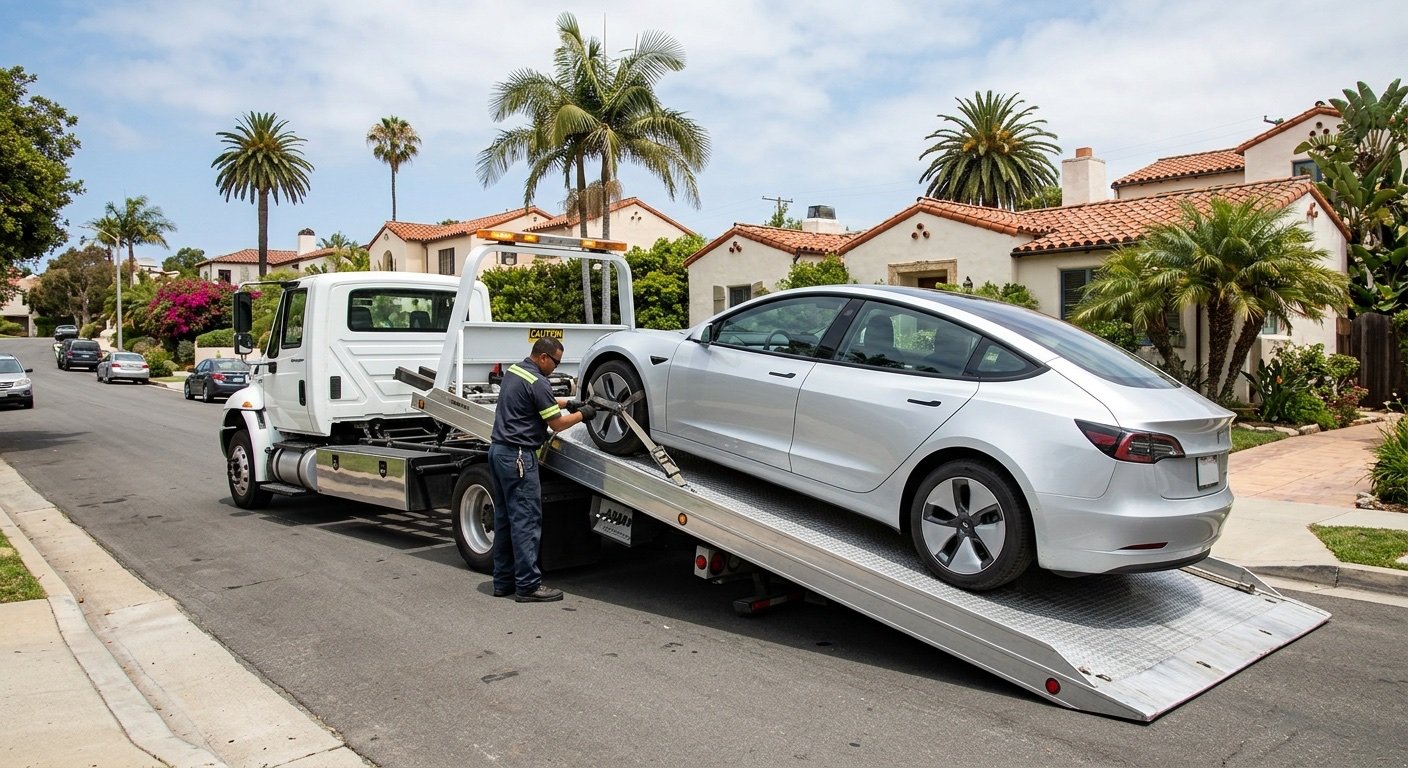
A flatbed tow truck carries the vehicle with all four wheels off the road. This prevents the drive wheels from rotating during transportation and can reduce the risk of drivetrain damage.
Flatbed towing can be particularly useful when:
- The EV has completely lost its charge
- The vehicle will not shift into the required towing mode
- The vehicle has been involved in an accident
- There may be damage to the wheels, suspension or drivetrain
- The manufacturer specifies flatbed transportation
- The vehicle needs to be transported a significant distance
- The vehicle is stuck and needs recovery before transportation
Tesla, for example, identifies a flatbed truck or comparable transport vehicle as the recommended transportation method for several of its models.
However, not every EV has identical towing requirements. Always check the owner’s manual or manufacturer guidance before deciding how the vehicle should be transported.
Can You Tow an EV With Two Wheels on the Ground?
You should not assume that an EV can safely be towed with two wheels on the ground.
Whether this is permitted depends on the vehicle and the manufacturer’s specific instructions. Some EVs require all four wheels to be off the ground during transportation.
For example, Tesla warns that certain vehicles should not be transported if there is any possibility of the wheels spinning and recommends wheel lifts with dollies or a flatbed when a flatbed is not available.
This is an important difference between EV towing and conventional towing.
If you are unsure about your EV’s requirements, tell the towing company the exact make and model before the truck arrives.
What If Your EV Has Run Out of Battery?
Running out of charge is one of the most common reasons an EV owner may need roadside assistance.
Unlike a petrol vehicle, you cannot solve an empty traction battery by bringing a small amount of fuel. If the main battery has reached a very low state of charge, the vehicle may need to be transported to an appropriate charging location.
Some EVs also have a separate low-voltage battery that powers systems such as electronics, locks and displays. A low-voltage battery problem can therefore look different from a completely discharged high-voltage battery.
The correct response depends on the vehicle.
Some manufacturers provide specific procedures for dealing with a low-voltage battery before loading the vehicle. Tesla’s transport guidance, for example, includes procedures for vehicles with no low-voltage power and instructions for using Tow Mode when applicable.
Do not assume that connecting an ordinary jump starter to an EV’s high-voltage battery is appropriate. The low-voltage and high-voltage systems serve different purposes.
What If the EV Will Not Turn On?
An EV that does not start may have several possible causes.
The problem could involve:
- A discharged traction battery
- A low-voltage battery
- An electrical fault
- A charging problem
- A software or control-system issue
- Damage following an accident
- A problem with the vehicle’s charging equipment
If the vehicle cannot be placed into the manufacturer’s recommended towing mode, forcing the wheels to move may not be appropriate.
A tow operator should know the vehicle’s condition before attempting to load it.
When you call for help, provide:
- Vehicle make and model
- Approximate model year
- Whether it is fully electric or a hybrid
- Whether the vehicle has any remaining charge
- Whether the vehicle powers on
- Whether it was involved in an accident
- Your exact location
- Whether the vehicle is in a garage, driveway, parking lot or roadside
This information helps the towing provider prepare the appropriate equipment.
EV Towing After an Accident
An electric vehicle involved in a collision requires additional care because the high-voltage system or battery may have been damaged.
Even if the vehicle appears switched off, high-voltage components may still require appropriate safety procedures.
Tesla’s emergency-response information warns that high-voltage systems can require specialised handling following an accident and recommends following vehicle-specific emergency-response guidance.
If your EV has been involved in a serious collision:
- Move yourself and passengers to a safe location if possible.
- Follow emergency-service instructions.
- Do not touch exposed high-voltage components or damaged orange cables.
- Do not attempt to repair the battery yourself.
- Tell the tow operator that the vehicle is electric.
- Mention any visible battery, underbody or wheel damage.
- Follow the manufacturer’s recommended transportation procedure.
If there is smoke, fire, unusual heat or other signs of a battery emergency, treat it as an emergency and contact emergency services.
What About a Dead 12-Volt Battery?
Electric vehicles can still have a conventional low-voltage electrical system even though their main propulsion system is electric.
A dead low-voltage battery can prevent an EV from unlocking, powering electronic systems or entering the correct towing mode.
This is different from having an empty high-voltage traction battery.
Depending on the vehicle, a low-voltage battery may be serviceable using the manufacturer’s specified procedure. However, the procedure varies between models.
Do not randomly connect cables to terminals you are unfamiliar with.
Instead, check the owner’s manual or tell the roadside provider that the vehicle has lost low-voltage power.
Towing an EV in Calgary Winter
Calgary winters can create additional problems for EV owners.
Snow, ice and freezing temperatures can contribute to:
- Reduced driving range
- Difficulty reaching a charging station
- Vehicles becoming stuck
- Frozen or difficult-to-access charging equipment
- Poor traction on snow and ice
- Battery-related roadside emergencies
If an EV becomes stuck in snow, a winch-out or recovery service may be required before the vehicle can be transported.
ARM Towing provides winch-out and vehicle recovery services for vehicles stuck in snow, mud or roadside ditches.
When recovering an EV, the recovery method should take the vehicle’s manufacturer requirements into account. Avoid attempting to drag an EV using an unsuitable attachment point or method.
Can an EV Be Winched Onto a Flatbed?
Yes, an EV can often be winched onto a flatbed, but the procedure should follow the vehicle manufacturer’s instructions.
Some vehicles have designated tow eyes or specific loading procedures.
For example, Tesla’s transporter instructions specify using the appropriate tow eye and Tow Mode when loading certain vehicles onto a flatbed. If the vehicle cannot enter the required mode, Tesla provides alternative procedures involving equipment such as dollies or tire skates.
This is why a tow operator should know the vehicle model before attempting to load it.
Do not attach a winch cable to random suspension, chassis or body components.
What Information Should You Give an EV Towing Company?
When requesting electric vehicle towing in Calgary, provide as much useful information as possible.
Tell the towing company:
1. The EV make and model
For example, provide the manufacturer and exact model.
2. The vehicle’s location
Give the street address or a clear description of where the vehicle is located.
3. The battery situation
Explain whether the battery is empty, nearly empty or showing an error.
4. Whether the vehicle powers on
Tell the operator if the displays, locks and other electrical systems are working.
5. Whether the vehicle was damaged
Mention accidents, wheel damage, underbody damage or visible battery damage.
6. Where the vehicle needs to go
The destination could be a charging station, dealership, repair facility, home or another location.
Providing these details before dispatch can help the towing company determine what equipment and loading method may be required.
Should You Tow an EV Yourself?
Self-towing an EV with a rope, strap or another vehicle is generally not something you should improvise.
The correct towing method depends on the vehicle’s drivetrain and manufacturer instructions.
There can also be additional risks if the EV has been involved in an accident or has suspected battery damage.
If you are stranded in Calgary, professional towing assistance can help determine how the vehicle should be recovered and transported.
EV Towing Checklist for Calgary Drivers
Keep this checklist in mind if your electric vehicle needs towing:
Before the Tow Truck Arrives
- Move to a safe location if possible.
- Turn the vehicle off if the manufacturer’s instructions allow it.
- Do not touch damaged high-voltage components.
- Do not attempt to repair the battery.
- Check your owner’s manual for towing instructions.
- Note the vehicle’s make and model.
- Check whether the vehicle has any remaining charge.
- Tell the towing company that it is an EV.
- Explain whether the vehicle was involved in an accident.
- Give the operator your exact location.
- Tell the operator where the vehicle needs to go.
During Loading
- Follow the tow operator’s instructions.
- Use the manufacturer’s designated tow points where applicable.
- Use Tow Mode only if your vehicle’s manufacturer specifies it.
- Avoid unnecessary wheel rotation.
- Make sure the vehicle is secured correctly.
- Do not allow damaged components to be used as attachment points.
When Should Calgary EV Owners Call for Towing?
You may need electric vehicle towing if:
- Your EV has run completely out of charge.
- The vehicle will not start or move.
- The low-voltage battery has failed.
- The vehicle cannot be placed into the required towing mode.
- You have been involved in an accident.
- Your EV is stuck in snow.
- A wheel or suspension component is damaged.
- The vehicle has a drivetrain or electrical fault.
- You need transportation to a dealership, repair shop or charging location.
In some situations, roadside assistance may solve the problem without transporting the vehicle. In others, towing is the safest option.
EV Towing in Calgary With ARM Towing
ARM Towing provides 24/7 towing and roadside assistance across Calgary and nearby areas.
Its services include flatbed towing, vehicle recovery and accident towing, winch-out and recovery, battery boost and jump-start assistance, flat tire changes and other roadside services.
The company specifically lists flatbed towing for vehicles including AWD and low-clearance cars, with all wheels off the road.
ARM Towing also provides vehicle recovery and accident towing around the clock.
When calling for EV towing, provide the exact vehicle make and model and explain the problem so the appropriate towing method can be considered.
Final Thoughts
Electric vehicles can be towed safely, but they should not automatically be treated exactly like petrol or diesel vehicles.
The correct towing method depends on the EV’s manufacturer, model, drivetrain, battery condition and circumstances. In many cases, a flatbed tow truck is an appropriate choice because it keeps the vehicle’s wheels off the road and avoids unnecessary wheel rotation.
If your EV has broken down, run out of charge, become stuck in Calgary snow or been involved in an accident, avoid improvising a towing method. Follow the manufacturer’s instructions and use appropriate professional towing equipment.
For 24/7 towing and roadside assistance in Calgary, ARM Towing provides flatbed towing, vehicle recovery and roadside support.
Frequently Asked Questions
Can electric vehicles be towed?
Yes. Electric vehicles can be transported by tow truck, but the correct method depends on the specific vehicle. Many EV manufacturers recommend a flatbed or another method that keeps all four wheels off the ground.
Is flatbed towing safe for EVs?
Flatbed towing is commonly recommended for EV transportation because it keeps the wheels off the road. However, the vehicle manufacturer’s specific towing instructions should always be followed.
Can you tow an EV with two wheels on the ground?
Do not assume that you can. Some EVs must have all four wheels off the ground during transportation. Check the owner’s manual or manufacturer’s towing instructions.
What happens if an EV runs out of charge?
An EV that runs out of charge may need roadside assistance or transportation to an appropriate charging location. The correct solution depends on the vehicle and its remaining electrical power.
Can an EV be jump-started?
Some EVs have a low-voltage battery that can require assistance, but this is different from charging the main high-voltage traction battery. Follow the manufacturer’s procedure rather than attempting an improvised jump-start.
Can an EV be towed after an accident?
Yes, but additional precautions may be required if the high-voltage system or battery has been damaged. Tell the towing provider that the vehicle is electric and explain the accident circumstances.
Can a tow truck recover an EV stuck in snow?
Yes. Professional recovery equipment can be used when an EV is stuck in snow, but the recovery method should take the vehicle’s towing and attachment requirements into account.
Should I use a regular tow truck for my EV?
It depends on the vehicle. Ask for the appropriate equipment and provide the tow company with your EV’s exact make and model. A flatbed may be recommended depending on the manufacturer’s requirements.

Moussa El Haddaoui is a digital content creator, web developer, and SEO specialist with a background in English Studies. He writes engaging, informative content and builds websites focused on user experience, search visibility, and quality. His interests include web development, AI automation, digital marketing, and creating useful online experiences.